AMEB Piano Series 19 Syllabus with Angela Turner
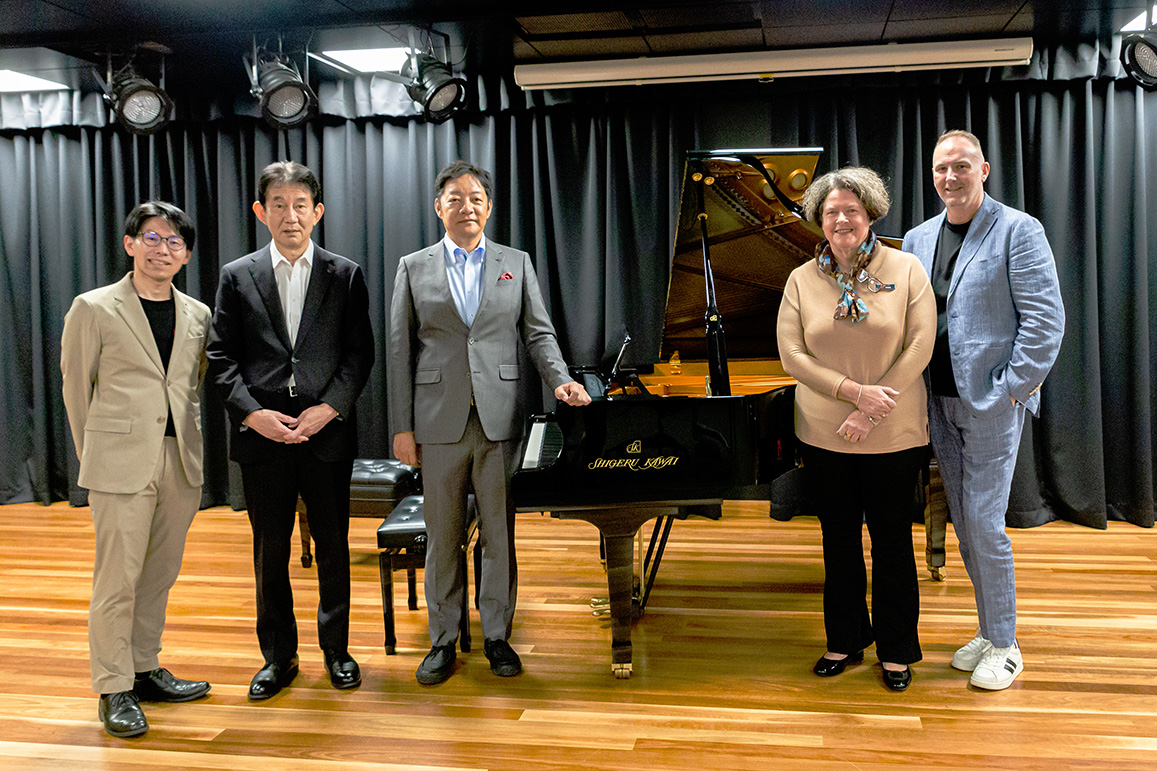
With the release of AMEB Piano Series 19 in November 2025, AMEB’s newest addition to the Piano syllabus, a fresh wave of repertoire is about to inspire teachers and students across the country. Featuring 128 newly selected piano works — from timeless classics to contemporary gems — the collection reflects the rich diversity of piano music today. At the heart of this project is Angela Turner, one of Australia’s most respected pianists, teachers, and editors. As a consultant for AMEB Piano Series 19, Angela oversaw every stage of repertoire curation, ensuring each piano piece offers both musical depth and educational value. We sat down with Angela to talk about how she discovered these works, what guided her decisions, and how this exciting new release will shape the next generation of pianists.
Let’s start with the big picture: what guiding principles shaped your selection of pieces for AMEB Piano Series 19? Were you looking to fill any specific stylistic or technical gaps from earlier syllabuses?
In terms of guiding principles, firstly, there’s many pragmatic considerations that are constantly in mind. You can find a wonderful, inspiring piece, but it might not fit within the time constraints of an exam, or it might have several passages that are technically a few grades higher than the rest of the piece, or places unreasonable demands upon smaller hands, and so on. So even though there’s much piano repertoire out there, there’s a lot of filtering that must take place, even at the first stage. To find the 128 piano pieces ultimately selected, there was an initial review of approximately 30,000 pieces. It took about 1.5 years to review and analyse the repertoire.
Alongside the pragmatic necessities, I was looking for pieces that might engage a player’s imagination, to explore a range of styles, sounds and characters. It is always a central consideration as to how a student might connect and engage with the selections, hopefully building their own sense of meaning through the music-making, and to provide a variety of experiences, including from a technical perspective, exploring different playing techniques and foundational movements. As there’s been about 100 years of AMEB piano grade books to this point, it felt worthwhile to search deeply to find pieces that are fresh to us all, alongside the traditional repertoire selections that we would expect from the comprehensive syllabus. I was very keen to bring new energy into the selections, to find delight in exploring humour and joyfulness.
Being an Australian exam series, it was important to showcase Australian composition wherever possible, and to also explore the multicultural nation that Australia is. For the first time, we have a work from the AMEB’s Australian Indigenous Composers project, with a beautiful piece by Brenda Gifford.
Ultimately, there are works from 23 different nationalities, including composers from the Asia-Pacific region. I was very grateful to Japanese and Vietnamese teaching colleagues who pointed me towards suitable publications and research websites that wouldn’t have been found without speaking the language.
Out of the new piano works, which one surprised you the most — perhaps something you discovered in an unexpected place or fell in love with instantly? Did you know of all the piano composers beforehand, or did you find some for the first time?
There were many discoveries, some in unexpected places, and plenty of piano pieces I fell for instantly! I certainly didn’t know all the piano composers beforehand – that made the process exciting. It’s hard to narrow it down to a single work, but some of my personal highlights are the Australian works. There’s two miniature masterpieces by Melbourne-based composer, Calvin Bowman. There are gems by Julian Yu, including an entertaining work called “A phone call to Mozart”, which combines snippets of Mozart, interjected by the Nokia ringtone (itself an excerpt of another work for guitar by Spanish composer, Francisco Tárrega). There’s beautifully crafted pieces by Elissa Milne, Ian Munro, Jo Kotchie, Sonny Chua, Michael Hannan, Philip Wilcher, Anne Cawrse, Sally Greenaway, Christopher Healey, Daniel McFarlane, Carl Vine and Ross Edwards, just to name a few.
There were also quite a few discoveries from our heritage Australian composers. I was very excited about a piano work composed in 1923 by Adelaide-based Hooper Brewster-Jones – he wrote the first set of pieces upon Australian bird song and bird calls, decades ahead of Messiaen, for example. Iris de Cairos-Rego was one of the founding piano teachers at the Sydney Conservatorium; there’s a lovely Arabesque of hers in Grade 6. Some teachers will remember the works of Lindley Evans fondly; I fell for a piece called The Coral Island, which depicts gently lapping waves around an island off the Great Barrier Reef in North Queensland. There are numerous pieces that explore Australian nature and scenery that I hope students and teachers will connect with.
Did any piano pieces almost make the cut but didn’t — and if so, what tends to be the deciding factor when two works are on the borderline?
There were many! During the initial review, about 600 piano pieces were shortlisted, and then 500 were analysed in detail. I felt that any of these pieces could have been selected. It comes down to looking at the combination of the selections, so there is a variety of keys, tempi, styles, time signatures, technical, expressive, maturity, etc. demands in each list and grade. There were a few occasions when I looked at the shortlisted selections for a particular list, and the works that first stood out to me as definite selections were all in the same key and time signature. Even though they were all standout pieces, students and teachers appreciate breadth in the choices, so you go back to the drawing board. I also had the privilege of working with my official reviewer, Dr Mark Griffiths, so if I was really split between a few excellent options, I’d present them to him and be grateful for his thoughts. 99% of the time, it was about striving for a worthy combination.
In the List A selections, for example, I aimed for the combination of a traditional Baroque work and a study, then a more contemporary example, perhaps written in the style or in homage, that contains similar musical and technical skills. But you shortlist multiples of everything. To be honest, there’s almost enough “great works that didn’t quite get selected for variety and balance reasons” for another series!
How much influence do trends in contemporary piano music (minimalism, film music, jazz crossover, etc.) have on your selections?
Given that Piano Series 19 was designed to sit within the Australian Music Examinations Board’s Comprehensive Syllabus, I wasn’t intentionally seeking out specific minimalist or jazz or film music examples. Given the diversity in the lists, there are works that can be seen to have some of those elements, but I wouldn’t classify them solely in those genres.
Were there any specific composers or styles you consciously wanted to introduce to Australian students for the first time?
There are numerous composers presented in the Series for the first time. As I mentioned earlier, I was very happy to work with Brenda Gifford as part of the AMEB’s Indigenous Composer’s project. There were a number of wonderful women composers who wrote with a deep understanding of the piano, yet because of historical factors, they did not have the same opportunities to be heard. There are several international composers that will be new to many. Numerous Australian composers are included for the first time; some well-known names are included with lesser-known works.
It wasn’t so much new styles, but where possible, I tried to explore different stages within eras and genres. For example, I wanted to look at composers like Galuppi and Cimarosa, and the various sons of Bach who were all quite influential; they also provide some insight into the transitions between and development within eras. Teachers will know, of course, that the calendar doesn’t tick over into 1750 and suddenly everyone is writing in the fully evolved Classical style (or into 1800s and the Romantic style, etc.) Hopefully, it’s interesting for students to have tangible examples of music from the broad Classical era that demonstrate style galante, Empfindsamer Stil (Sensitive Style), Sturm und Drang (Storm and Stress), and so on, to help them understand how an era progresses.
Another example that comes to mind was through the nocturne: there’s a beautiful piece by Canberra-based Sally Greenaway called “Dawn of Evening”, which combines the influences of a Romantic nocturne with Irish folk music in her own, deeply expressive way. I was excited to be able to present this in Grade 5; in Grade 6, it is followed by a nocturne of Irish-born John Field. Given the prominence of Chopin’s nocturnes, it’s easy to forget that Field was the inventor of the genre, and that he spent decades living in Russia, experiencing the broader cultural intersections of Europe as well. I didn’t include a Chopin example, as there are numerous already in the manual lists, and in both Series 17 and 18, and therefore already accessible to teachers; but to complement them with something similar but different, I placed a work by Russian composer Anatoly Lyadov in Grade 8. It is certainly influenced by Chopin’s examples, and feels like Chopin to play in many ways, with added late-Romantic richness that I hope people will love. Hopefully, in some way, these little threads can illustrate how genres evolve and grow over history.
I had other ideas of possible connections before I started but wasn’t sure how they might unfold. First and foremost, you’re tasked with choosing works that are suitable for an exam series; but from those initial ideas, you see where the selections might lead you, explore some of those paths and try the side quests. One of the more prominent themes that successfully emerged was the interaction between teachers and their students. Let’s take Beethoven as an example: we would expect Beethoven in the series, but there’s also a wonderful piece by Beethoven’s childhood composition and piano teacher, Christian Neefe. I think his work demonstrates something of the forward momentum and dramatic intensity that we often observe in Beethoven’s writing. There’s a charming work by Ferdinand Ries, who was one of Beethoven’s students. Czerny was another of Beethoven’s students, and there’s a work by Australian composer Julian Yu called “Czernissimo”, which pays homage to numerous Czerny’s etudes and has a lot of fun in the process. Beethoven also famously studied with Haydn. And alongside works by Haydn, there are works by Marianna Martinez and Johann Nepomuk Hummel, who were both Haydn’s students. Martinez is documented to have played piano duets with Mozart! Hummel also spent two years living in Mozart’s house, having lessons. Hummel and Beethoven were friends (and occasional rivals!) and go on to become two of the great pianists and composers of Europe at the time. While Hummel’s impact on the next generation was also considerable, his music is less well-known today. And so it continues. These connective threads between composers, even if tangential, help to provide awareness of the musical world, and hopefully enrich our historical understanding.
There are many of these threads, and they often follow through to the present day. It wasn’t the core focus of the series, but I’m very happy they’re there because it shows how, as musicians and pianists, we are all connected through music from long ago through to now, paying homage to those before us and helping to develop those to come.
If you had to describe the “personality” of Australian Music Examinations Board's Piano Series 19 in a few words, what would it be? How does it differ from previous series?
I’d hope it might be viewed as rich with discovery but also balanced by tradition. Series 19 will sit happily alongside previous series, but also offers, I hope, a fresh set of pieces and ideas to explore over the next decades.
Some teachers still prefer older AMEB series because they know the piano pieces inside-out. What would you say to encourage them to embrace the new repertoire?
We all like to have piano pieces that we know inside out! And Series 19 contains some of these favourites; they offer so much pedagogical value to students, you want to have them on hand. However, there’s also so much interesting repertoire in these new grade books that I hope everyone will find something to embrace and carry forward. If you’ve been teaching for decades, I think it’s exciting to come across a work by a well-known composer that you’ve never seen before! In the multiple stages of the review process, in the trials with my own students, in previews to teachers, the feedback has been enthusiastic and positive. Some of most unfamiliar music might be from different cultures and countries, but it has been tried and loved outside of Australia for decades. And different students need and appreciate different things! Once the series is accessible, I’d like to be optimistic and hope that teachers will be open-minded to give things a try. I’d suggest listening to the recordings that will become available; hopefully, that will encourage people to embrace the options excitedly!
There’s no doubt that teachers have plenty of choice: access to all the standard repertoire in the manual lists, or in previous series or collections that you and your students might already own. Series 19 contains some repertoire that would be more difficult or expensive for teachers and students to otherwise have access to, and brings some great works back into print. Not everyone would choose to spend years working through 30,000 pieces to make these choices; I don’t think any exam board typically expects that of any consultant! But I hope that investment of time and thought makes this a worthwhile series for all who use it.
How do you hope AMEB Series 19 will shape the musical imagination of the next generation of pianists?
It has become a tradition in the grade books to have a quotation on the first page, and for Piano Series 19, it is by the wonderful concert pianist, Angela Hewitt. I’ll share it here because it has deep resonance for my hopes:
For a pianist’s message to have meaning, it must have emotion behind every note, it must tell stories, it must transmit a work of transcendent beauty. Every fibre of your being, from head to toe, participates in a good performance.
I hope the repertoire will inspire students to conceive and tell their own stories, and that the variety of learning experiences and styles will help to provide a technical and musical foundation. I hope it assists to develop an understanding and curiosity about the music they play, and to keep growing. This cannot be achieved by a series alone, of course; students always need the support and wisdom of their teachers, and dedicated time playing at the piano. Perhaps one day, students might find their own compositions featured in a future series, or enjoying teaching the repertoire themselves!
Do you have a personal favourite — a piece that speaks to you on a deeper level, either musically or sentimentally?
There are many favourites… it’s not possible to pick just one! These pieces have been running around in my mind for a while; even now I will catch myself randomly singing excerpts without immediately realising what it is I’m singing. There are numerous earworms! When I see some of the pieces, I’m reminded of the responses and feelings that occurred when first playing them through, and it makes me want to play them again. I love the Australian works.
If pushed for others… I find myself coming back to a piece in Grade 8 by Samuel Coleridge-Taylor, which comes from his “Three-fours” Valse Suite. It has a harmonic richness, is beautifully written with a sense of nobility yet combined with a tenderness and poignancy that I find compelling. I was charmed by Melanie Bonis’ Impromptu in Grade 7. In Grade 3, I’ve played Julian Yu’s A phone call to Mozart so many times, and yet it makes me smile every time. I almost feel bad for singling out just these pieces – there are so many more!
If you could give one piece of timeless advice to students choosing exam repertoire — beyond “pick what you love” — what would it be?
Perhaps, try not to get intimidated by how it looks on the page, or how many pages it is! The number of pages doesn’t always equate to difficulty or length! Sometimes large sections (like a da capo return) have been written out to prevent an impossible page turn, or there is so much repetition and patterning in the writing that it may take you less time to learn than something else that “looks simpler”.
If you can, try to learn more pieces than you need for the exam – you’ll have grown in the process, your sight reading will improve the more you read, and then you can choose your favourites and what you feel shows you in the best light for the exam.
Whether you’re a student searching for your next musical challenge or a teacher eager to explore fresh repertoire, Piano Series 19 offers something for everyone — from lyrical miniatures to virtuosic showpieces and everything in between. Kawai is proud to support AMEB in nurturing musical growth through innovative and inspiring piano literature.
.
The new AMEB Piano Series 19 books are now available online and through participating retailers. Explore the full range and bring the next chapter of Australian piano education to your studio today.